Point 1
What They Actually Are
Different tools. Different jobs. Not competitors.
OpenClaw
Life Operating System
- General-purpose autonomous agent
- 50+ integrations: chat, calendar, smart home, email
- Connects via Signal, Telegram, Discord, WhatsApp
- Your digital employee for life tasks
Claude Code
Coding Agent
- Lives in your terminal, ships features
- Maps entire codebases in seconds
- 80.9% SWE-bench Verified — highest ever
- Agent Teams: multi-agent collaboration
"Comparing these two is like comparing a Swiss Army knife to a surgical scalpel."
One does fifty things. The other does one thing better than anything else on the planet.
Head to Head
6 Categories That Actually Matter
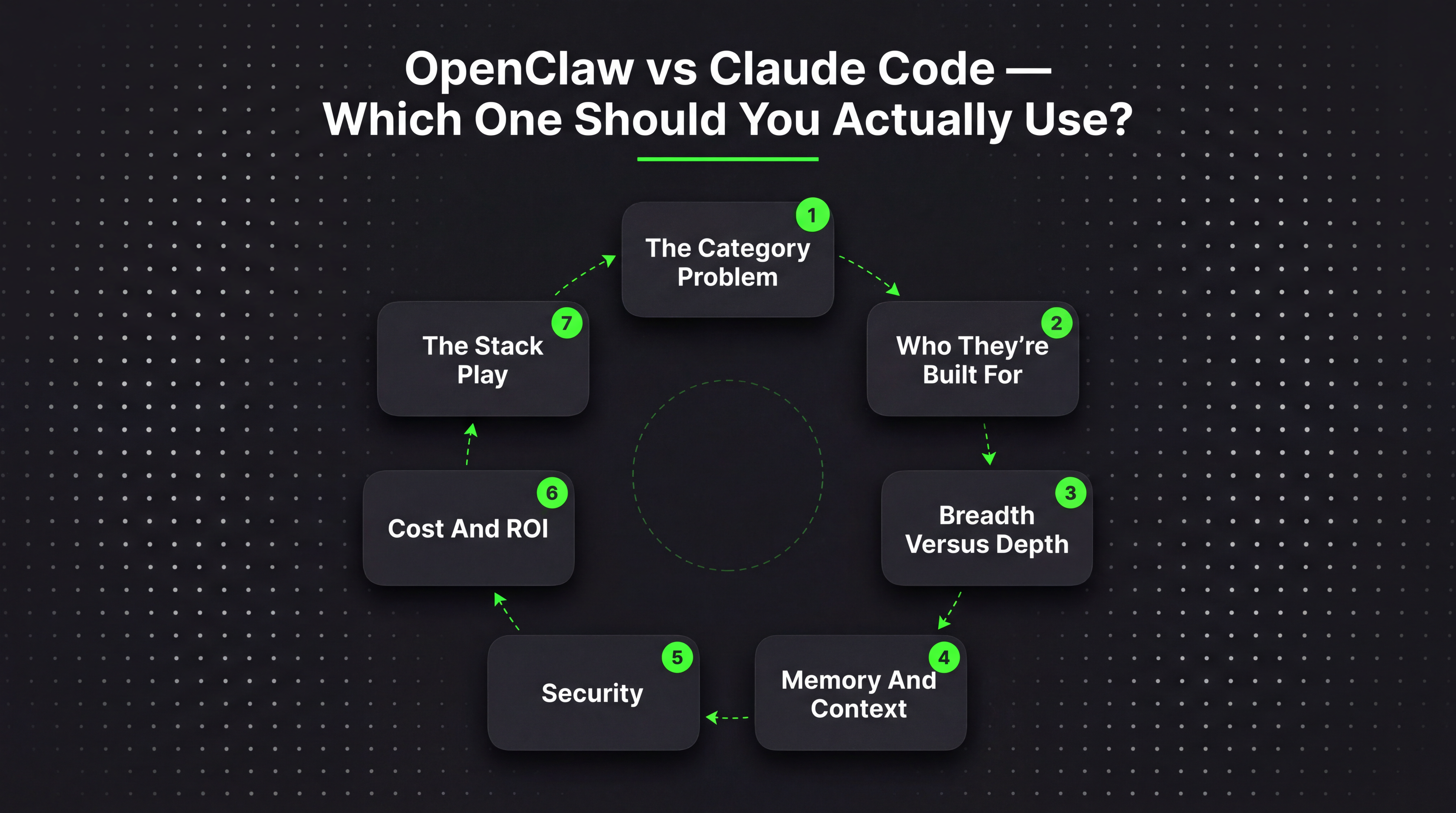
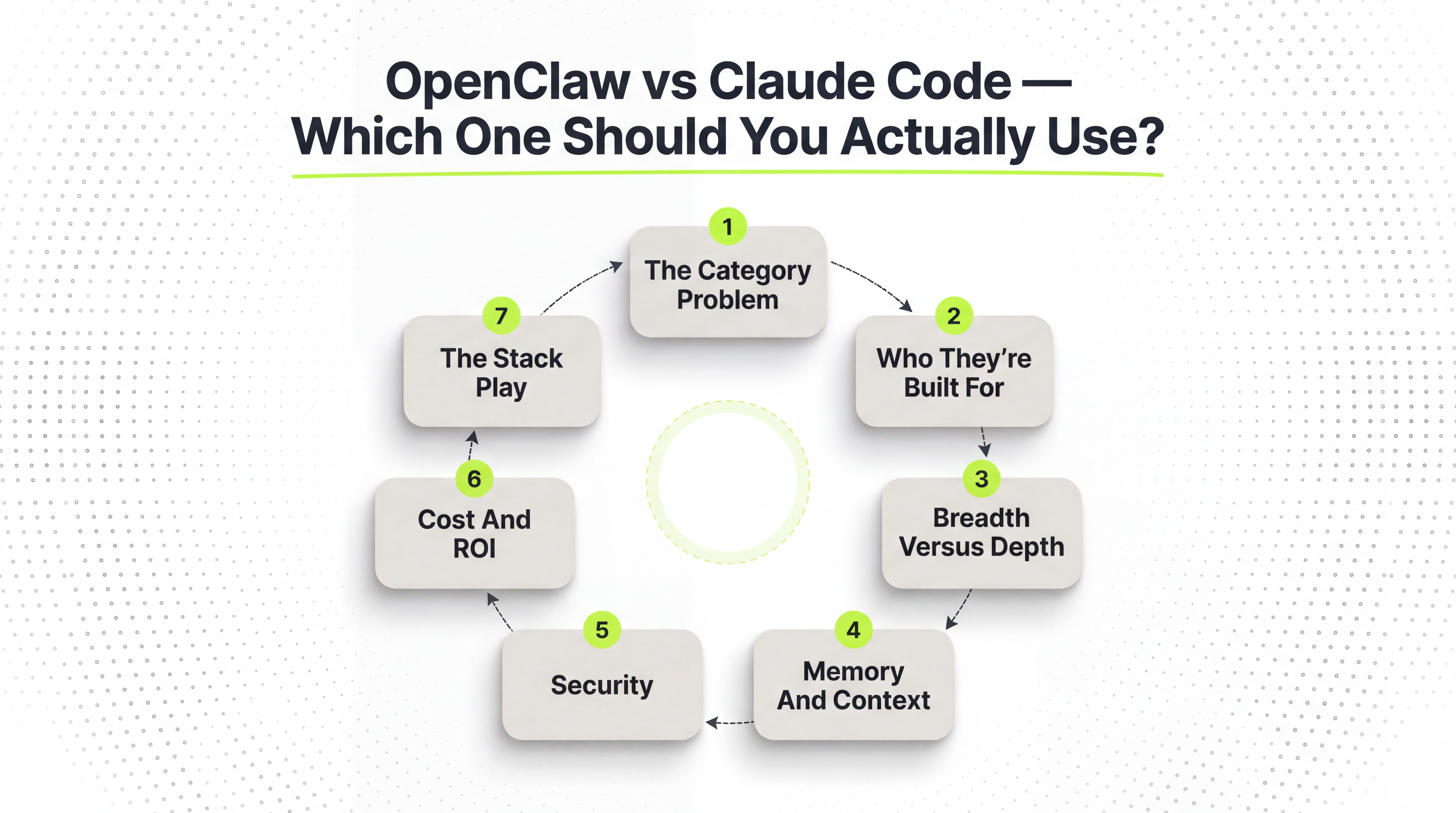
The Category Problem
Life OS vs coding agent. Like comparing Slack to VS Code. They solve fundamentally different problems.
Who They're Built For
OpenClaw: non-technical founders wanting automation. Claude Code: developers who ship production code.
Breadth vs Depth
OpenClaw is model-agnostic with thousands of community skills. Claude Code goes ten levels deep into one codebase.
Memory & Context
OpenClaw: persistent memory out of the box. Claude Code: session-based by default, but configurable project-level persistence.
Security
OpenClaw: open ecosystem trade-offs, published CVEs, supply chain risks. Claude Code: smaller surface area but not immune — terminal access and cloud model trust carry their own risks.
Cost & ROI
Neither tool is cheap at serious usage. OpenClaw is free but API and hosting costs scale. Claude Code is subscription-based at ~$6/day for active developers. The real question: which saves you more time?
Point 5 — Deep Dive
The Section Nobody Else
Wants to Do Properly
Additional sources: ClawHavoc Campaign · Microsoft Security Blog · DataCamp Analysis
"The openness that makes OpenClaw powerful is the same openness that creates these attack surfaces."
That's not a bug in the philosophy. It's the trade-off.
The Framework
Use OpenClaw When...
Reach for OpenClaw
- You want to automate life tasks without code
- You need a personal assistant across messaging apps
- Calendar management, email summaries, smart home control
- You want model flexibility (GPT, Gemini, Claude, local)
- You need persistent memory that works out of the box
Reach for Claude Code
- You're writing, debugging, or refactoring code
- You need deep codebase understanding and context
- CI/CD pipelines, test generation, architecture decisions
- You want multi-agent engineering workflows
- Security and sandboxing are non-negotiable
The Flywheel
Key Points at a Glance
Go Deeper
The what is right here.
The how is in the Vault.
Workflows, configs, decision frameworks, and a community of builders actually doing this. Join the AI Founders Vault.